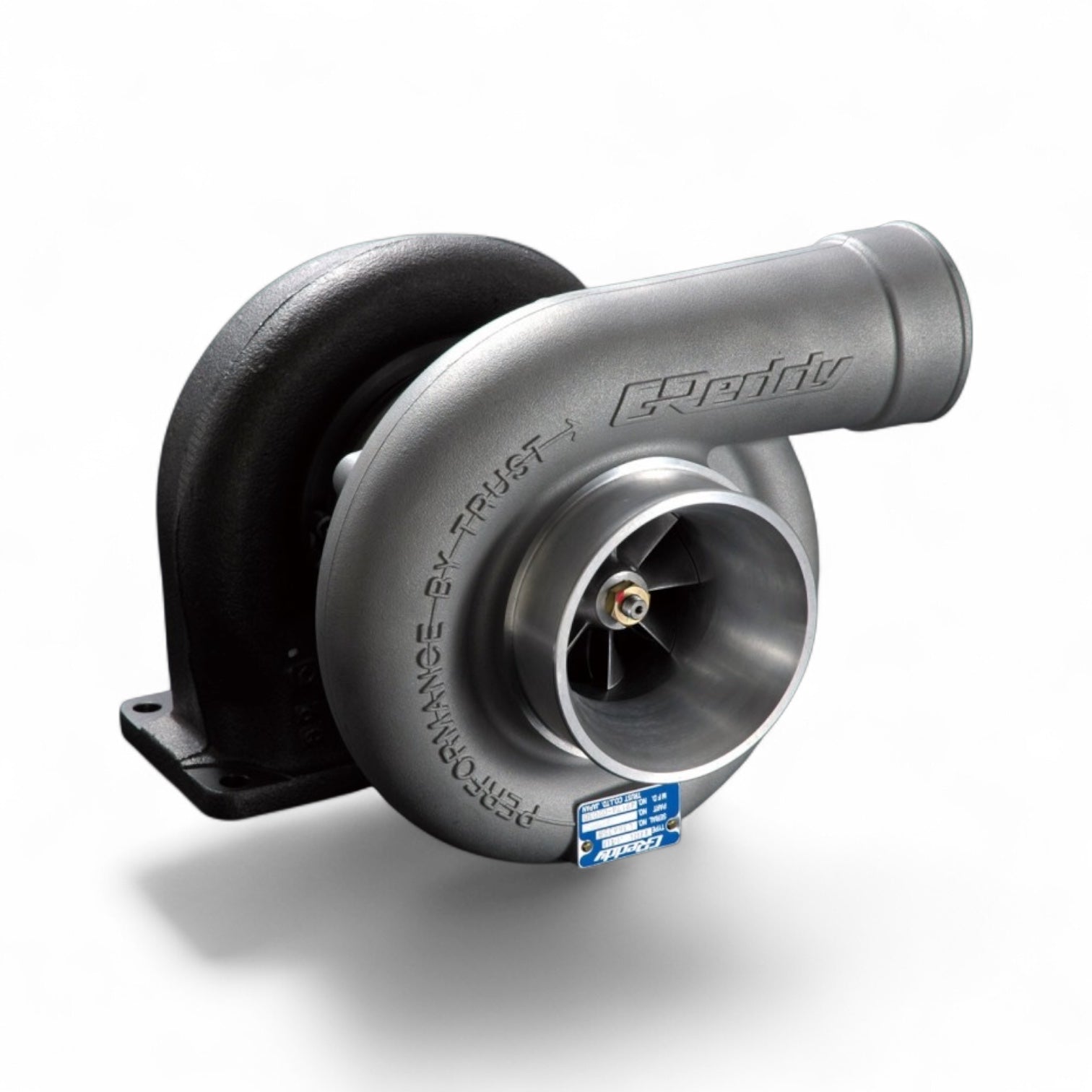
TRUST GReddy TD06SH -20RX 16㎠

Manufacturer | TRUST trust |
Product name | GReddy TD06SH -20RX 16 cm² |
| Delivery Time | Usually 1-3 business days ( When the manufacturer is out of stock, approximately (1 month) |
Features of the GReddy turbocharger
The mechanism and characteristics of turbochargers.
High-efficiency compressor and turbine housing and wheel
A turbocharger uses the "pressure" of exhaust gases expelled from the engine to rotate the turbine wheel, and a compressor wheel mounted on the same axis rotates together to provide boost. Therefore, if the turbine wheel is small, the turbine will rotate from low RPMs even with a small displacement engine, but if the turbine wheel is large while the displacement is small, the turbine will not rotate until the RPMs where the exhaust gas pressure is high. It can be said that the relationship between the "size and shape of the turbine wheel" and the "exhaust gas pressure" greatly affects the engine characteristics. Once you understand the principle of turbochargers, you might think, "If the turbine wheel is small and the compressor wheel is large, wouldn't it be possible to obtain high boost pressure even with a small displacement engine?" This is precisely what Trust excels at: the "hybrid turbine." Considering the rotational balance of the turbine wheel and compressor wheel, we select the most efficient size, shape, and number of blades possible. Furthermore, by combining these characteristics with a housing that matches them, we create a "high-performance turbine that can obtain high output even with a small displacement," which is the characteristic of the GReddy turbocharger.
The advantages of floating metal
GReddy turbochargers are committed to using floating metal bearings. This is because it is the bearing system with the least resistance when actually in use. When you disassemble floating metal bearings, you may see that the metals are in contact with each other, which might lead you to believe that they are bearings with high frictional resistance. Also, when you turn the compressor wheel by hand with a cold turbocharger, it will feel heavier than a ball bearing system. So why are floating metal bearings superior? The answer lies in the presence of engine oil. When the engine is started and hydraulic pressure is applied, and the engine oil warms up, the shaft floats in the center of the metal bearing, covered in oil. This is a "fluid bearing system" where the shaft is supported only by oil. This is where the name "floating metal" comes from. In other words, when you disassemble the metal bearings, you are draining the most important component, the engine oil, so it is not an exaggeration to say that you are overlooking the most important device. When actually in use, the space between the metal bearing and the shaft is filled with oil, and the metals do not touch each other at all. To put it simply, comparing the rotational resistance of the compressor wheel when the turbocharger is cold is meaningless because the floating metal's performance isn't being fully utilized. What matters is the turbocharger's performance when it's actually in use, and comparing its performance when the engine is stopped isn't very meaningful. When the turbocharger reaches its actual operating temperature, which will have less resistance: a bearing system where metals are in contact, albeit at points, or a fluid bearing where no metals are in contact at all? Furthermore, since fluid bearings don't require the circulation of coolant like ball bearings, you can see that no frictional heat is generated around the metal.
When pursuing performance and convenience in the temperature range where turbochargers are actually used, one inevitably arrives at the floating metal of fluid bearings.
*Delivery time is subject to manufacturer stock availability.
Delivery time: 1-3 business days
If the manufacturer is out of stock, delivery may take approximately one month.
If you are in a hurry, please contact us before purchasing.
Frequently bought together
TRUST GReddy TD06SH -20RX 16㎠